If you found this website useful, please consider donating to help support our online existance. Donations are managed by Fifth House Web Management Services. Thank you!
|
CURRENT MOON 15° Virgo 54' 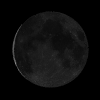 1% of Full Waning crescent NOT Void of Course | |
|
|
CURRENT MOON 15° Virgo 54' 1% of Full Waning crescent NOT Void of Course | |
|
Although Moon Tracks Astrology Calendars already has Void of Course information on one of its calendar systems, it has been decided to bring the Moon's Void of Course Dates Table onboard to provide current information quickly, efficiently and concise. The site's original Void of Course (VoC) calendar on Moon Tracks is set for one time zone; Pacific Standard Time (PST). The Void of Course info on this page is set up for UTC, but it is also adjustable.
The Void of Course Date Table now provides adjustable UTC-based information. You can adjust the dates/times to coordinate with your particular timezone. The adjustments are in whole hours only. There are no 1/2-hour time zone adjustments. You can easily adapt for Daylight/Summer Saving Time based on your particular region. The VoC table covers two months of VoC events; the current month and the next month. [UTC = Coordinated Universal Time, aka GMT Greenwich Mean Time] Learn More about what it means when the moon is void of course.
| Void of Course Schedule 2025 September & October | |||||||||||||||||||||||||||||||||||||||||||||||||||||||||||||||||||||||||||||||||||||||||||||||||||||||||||||||||||||||||||||||||||||||||||||||||||||||||||||||||||||||||
| |||||||||||||||||||||||||||||||||||||||||||||||||||||||||||||||||||||||||||||||||||||||||||||||||||||||||||||||||||||||||||||||||||||||||||||||||||||||||||||||||||||||||
United States Time Zones Resource
What is VoC?
Other types of VoC?
What should I expect during VoC?
How do I use the VoC table?
Personalized VoC Dates w/DayWatch Calendars
It has been brought to our attention that the time zones for some in the United States is too difficult to compute. We are including a link to a United States Time Zones Page listing all the states and exceptions that we are aware of utilizing which time zones. We will leave it up to you to figure out whether your region is currently using Standard Times or Daylight Saving Times.
The calculations are derived from the observation of the last Ptolemy aspect to the Moon's ingress into the next sign. In simpler terms, immediately after the Moon forms the last Major Aspect to another planet from the sign that the Moon is transiting, until the Moon moves into the next sign, the Moon is considered to be Void of Course. What is a Major Aspect? If we think of the universe in terms of a huge circle surrounding Earth, we can begin to think of slicing that circle up into sections. The aspects are merely angles formed within the 360 degree circle. A 90 degree angle is referred to as the Square Aspect. Other Major Aspects in Ptolemy are: conjunction, 0 degree; sextile, 60 degrees; trine, 120 degrees; and opposition, 180 degrees. There are many other degrees used in Astrology. In this case, for these VoC tables, only the major aspects will be used to determine the beginning of the Void of Course event.
Yes, it can occur on rare occasions. When the Moon transits through an entire sign, without forming any major aspect, Julius Firmicus Maternus deemed that type of Moon's transit to be a Void Moon throughout the entire transit.
On occasion, a guest will ask for opinions about other Astrologers who use different definitions for the Void of Course Moon. Some astrologers include the minor aspects along side the major aspects, thereby shortening the length of time that the moon is Void of Course. Some astrologers will ignore the Moon's transiting aspect patterns altogether, and use specific degrees within each sign as being the point in which the Void of Course Moon will begin and end. This may work for them based on their interpretation. What some people consider to be the VoC Moon may be more closely associated with the Anaretic Degree of the sign. The Anaretic Degree is the last active degree of any sign; aka 29th degree. This degree should NOT be confused with the Void of Course. This is, at most, all that will be said in reference to other astrologers' Void of Course Moon delineations.
The Void of Course (VoC) is similar to a short respite or a reprieve of emotions before the Moon journeys into the next astrological sign. The Moon rules over our feelings, emotions, nurturing feminine side (yes, even men have a nurturing feminine influence), as well as our childhood memories and family matters. Depending on which sign the Moon transits, that sign's energies will be blended into, or at the very least, awash over our natural Moon Sign's tendencies. This is one reason why our emotions and moods always seem to be in a state of flux, internally. When the Moon begins into a Void of Course period, these areas of our life seem to hit a disconnect. We encounter a short period of emotional confusion, mood fatigue, or even simply feel emotionally and physically rundown. We may not be able to rely on our usual "gut" decision-making. It is not advisable to initiate new concepts during the VoC Moon. For example, many students complain of not being able to remember what was taught during the Moon's Void of Course transit. From a psychological perspective, Learning and Memory are both closely associated with Emotions. When our emotions are dampened by the Void of Course period, we have a difficult time retaining new information. We must rely on the information that we already have, which may be insufficient once the Void of Course Moon has finished up. This is why so many astrologers describe this period as being "lost time" because we have a harder time staying on task, paying attention to details or flat out missing important information. Yet, the VoC period is useful if we have the ability to kick back, postpone making important decisions, and simply enjoy being "one" with the Void Moon. A great article to refer to on the Moon's Void of Course energies can be found on The Mountain Astrologer (Archive.org).
The Void of Course (VoC) table is set up to show you two months of VoC beginnings and endings. The table is defaulted to the Coordinated Universal Time, aka UTC or UTC(0). You can adjust the time zone to your region with the plus (+) or minus (-) radio buttons and the hours in the drop down window. If you live in the Western hemisphere, use the minus (-) radio button. Eastern hemisphere residents will use the plus (+) radio button. Let's use the Pacific Time Zone as an example. During the Standard Time (PST) the time difference from UTC is -8. Click on the minus radio button and select 8 from the dropdown window then click the "Change" button to adjust the time. During the Daylight Saving Time (PDT), the time difference from UTC is -7. Same operations with a slightly different time outcome. If you do not know your region's Time Zone calculation, you can visit Date and Time | Accessible The Time Now *(The link will open in a new window). Type in your town/city or closest major city to find the (UTC offset) for your timezone indicated in parentheses under the city. That will be your clue for the time zone offset on this Moon Void of Course date list.
If you know your timezone, but can't remember whether you are a plus or minus, remember that either of the America continents are a minus (-) and most of the other continents, (Europe, Asia, Africa and Oceania) are plus (+).
| Close It |